Sep . 19, 2025 15:25 Back to list
Premium Timber Beam H20 Formwork - Strong, Durable H20 Beams
Understanding the Modern Timber Beam H20 in Formwork Systems
In the rapidly evolving landscape of B2B construction, the efficiency and reliability of formwork components are paramount. Among these, the timber beam H20 stands out as a critical element, central to robust and flexible slab and wall formwork systems. Engineered for superior performance and exceptional durability, these beams are indispensable for contemporary construction projects demanding high standards of safety, cost-efficiency, and environmental responsibility. This comprehensive guide delves into the technical intricacies, applications, and strategic advantages of the H20 timber beam, providing insights crucial for procurement specialists, project managers, and structural engineers.
The `H20` designation refers to its characteristic H-profile and a standard height of 20 centimeters, optimizing its strength-to-weight ratio for demanding structural support. Utilized extensively in various construction scenarios, from intricate architectural designs to large-scale infrastructure, the H20 timber beam delivers consistent performance that underpins project success.
Industry Trends and Market Dynamics for H20 Timber Beams
The global construction industry is witnessing a significant shift towards sustainable and efficient building practices. For formwork H20 timber beam manufacturers, this translates into increased demand for products that offer extended reusability, reduced material waste, and lower carbon footprints. Key trends include:
- Sustainability Focus: A growing emphasis on certified timber from sustainably managed forests and the use of eco-friendly adhesives. This addresses both environmental concerns and regulatory requirements.
- Lightweight Design: Continuous innovation in manufacturing techniques to produce lighter yet stronger H20 timber beams, facilitating easier handling, faster assembly, and reduced labor costs on site.
- Enhanced Durability & Coatings: Development of advanced protective coatings that resist moisture, UV radiation, and mechanical abrasion, significantly extending the service life of formwork h20 timber beam for shuttering and minimizing replacement frequency.
- Digital Integration: Compatibility with Building Information Modeling (BIM) systems, enabling precise planning, material optimization, and streamlined project execution, positioning providers as leading timber beam formwork companies.
- Global Supply Chain Resilience: Diversification of sourcing and manufacturing locations to ensure robust supply chains, particularly for high-demand regions like China H20 timber beam for shuttering markets.
These trends underscore the evolving expectations of the B2B market, driving suppliers to innovate and refine their offerings to meet sophisticated project requirements.
Detailed Manufacturing Process of H20 Timber Beams
The production of a high-quality H20 timber beam involves a precise, multi-stage manufacturing process designed to achieve optimal structural integrity and longevity. Adherence to stringent quality control at each step ensures consistent performance:
1. Material Sourcing & Selection
Materials: Primarily high-quality, kiln-dried softwood lumber (e.g., spruce, fir) from certified, sustainably managed forests. Lumber must meet strict criteria for density, straightness, and absence of major defects. Adhesives are typically waterproof, high-strength resins like Melamine-Urea-Formaldehyde (MUF).
Process: Raw timber is meticulously inspected and sorted to ensure only prime lumber enters the production line.
2. Lumber Preparation & Finger Jointing
Process: Boards are cut to specified lengths and planed for smooth surfaces. Shorter pieces are precisely finger-jointed together using specialized CNC machining, creating continuous, defect-free flanges. This ensures uniform strength throughout the beam's length.
Advantages: Maximizes timber utilization, improves structural consistency, and allows for custom lengths, critical for H20 timber beam for slab formwork applications.
3. Web Production & Assembly
Materials: Plywood or OSB sheets (often 3-ply for enhanced stability) are cut to the exact web height (typically 120-130mm for a 200mm beam).
Process: The prepared top and bottom flanges are glued to the web using automated presses, forming the distinctive H-profile. High-frequency or hot-press bonding ensures rapid and strong adhesion.
4. Pressing, Profiling & Finishing
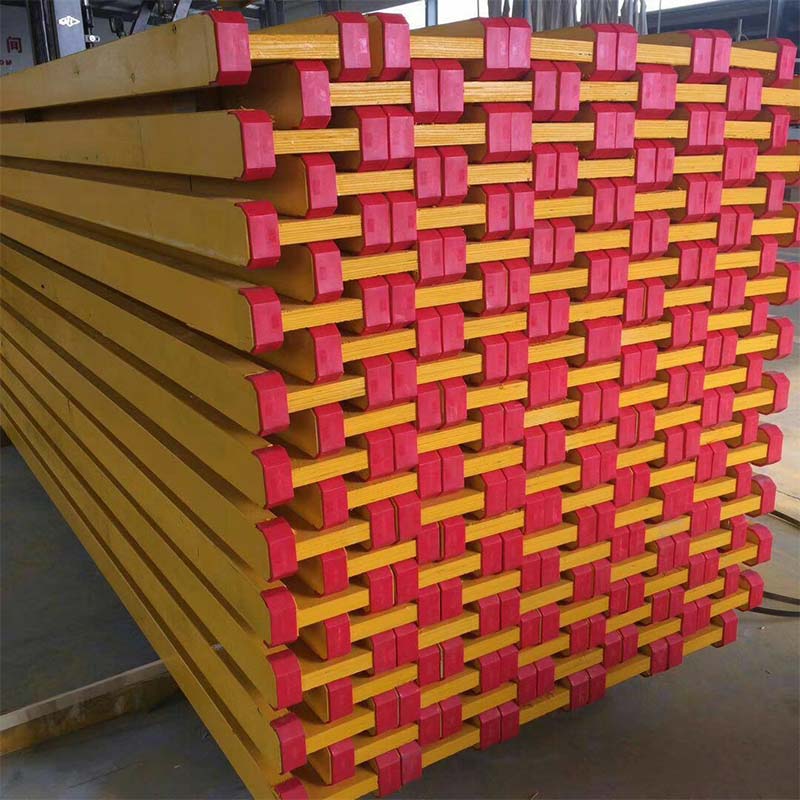
Process: Beams are pressed under high pressure to ensure optimal adhesive bond. After curing, they are trimmed to exact dimensions. Ends may be sealed, and the entire beam is typically coated with a water-resistant, durable protective paint (often yellow or orange).
Advantages: Enhanced protection against moisture, UV radiation, and minor mechanical damage, extending service life and visibility on site.
5. Quality Control & Testing
Testing Standards: Each batch undergoes rigorous testing to meet international standards such as EN 13377 (European standard for H20 beams). Tests include bending strength, shear strength, bond integrity, moisture content, and dimensional accuracy.
Service Life: With proper care and storage, H20 timber beams typically offer a service life of 20-30 reuses, making them a highly cost-effective and sustainable solution for timber beam formwork manufacturers.
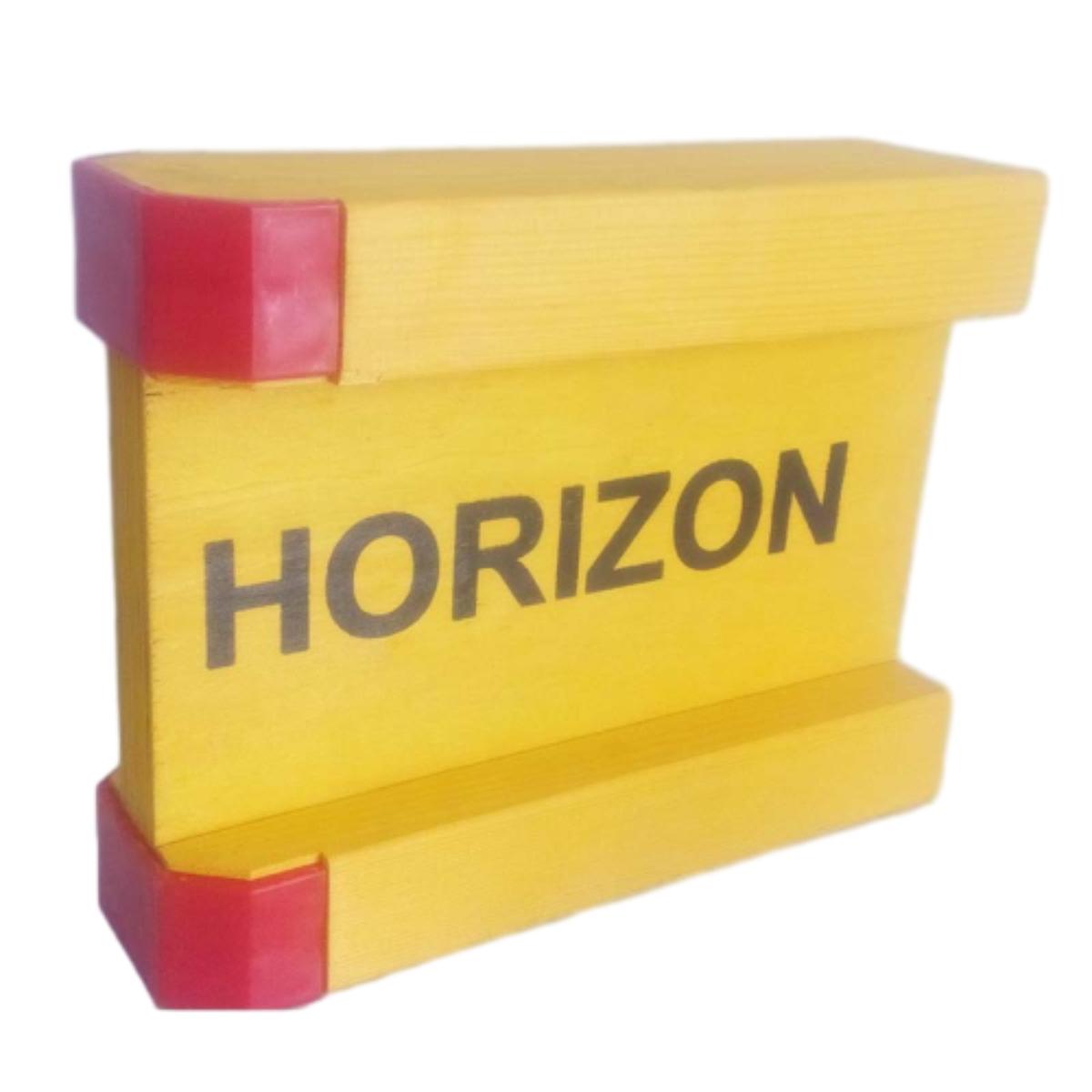
Technical Specifications and Parameters
The precise engineering of the H20 timber beam is reflected in its technical specifications, which are critical for structural calculations and on-site performance. Key parameters:
| Parameter | Value / Description | Units / Standard |
|---|---|---|
| Beam Height (H) | 200 | mm (approx. 7.87 inches) |
| Flange Width (B) | 80 | mm (approx. 3.15 inches) |
| Flange Thickness | 40 | mm (approx. 1.57 inches) |
| Web Thickness | 27 - 33 (typically 3-ply) | mm |
| Weight (per linear meter) | 4.8 - 5.5 | kg/m |
| Moment Capacity (Mmax) | 5.0 | kNm |
| Shear Capacity (Qmax) | 11.0 | kN |
| Modulus of Elasticity (E) | 10,000 - 11,000 | N/mm² |
| Standard Lengths | 1.95 to 5.90 (in 30cm increments) | meters |
| Protective Coating | Water-resistant, UV-stabilized paint | Yellow/Orange (typical) |
| Certifications | EN 13377, CE, ISO 9001 | Industry Standards |
These specifications underscore the robust engineering behind each H20 timber beam, ensuring its suitability for demanding formwork applications. The high moment and shear capacities provide the necessary structural support for various concrete pouring pressures.
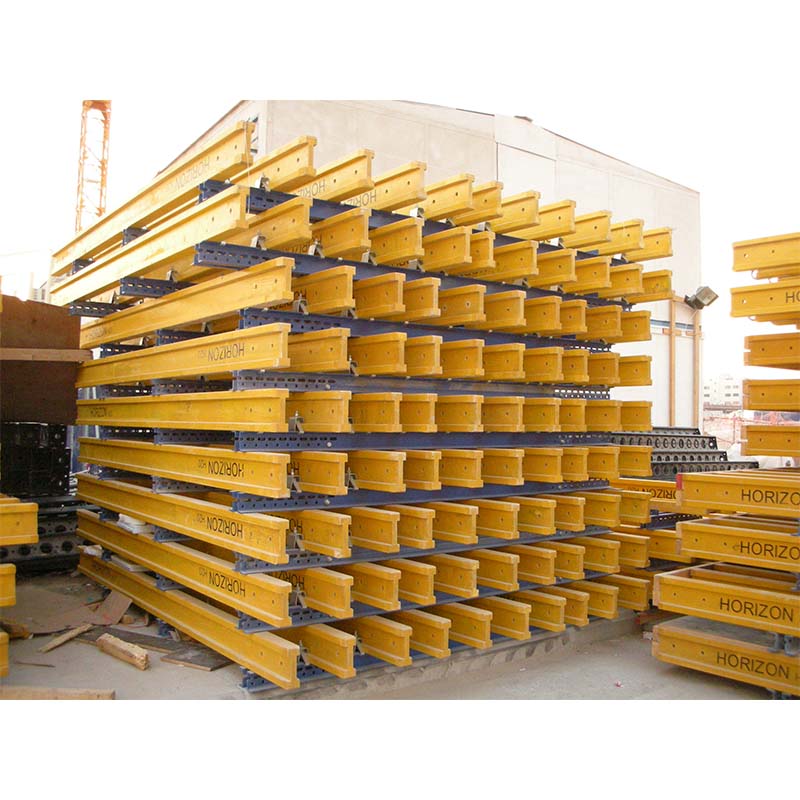
Application Scenarios and Technical Advantages
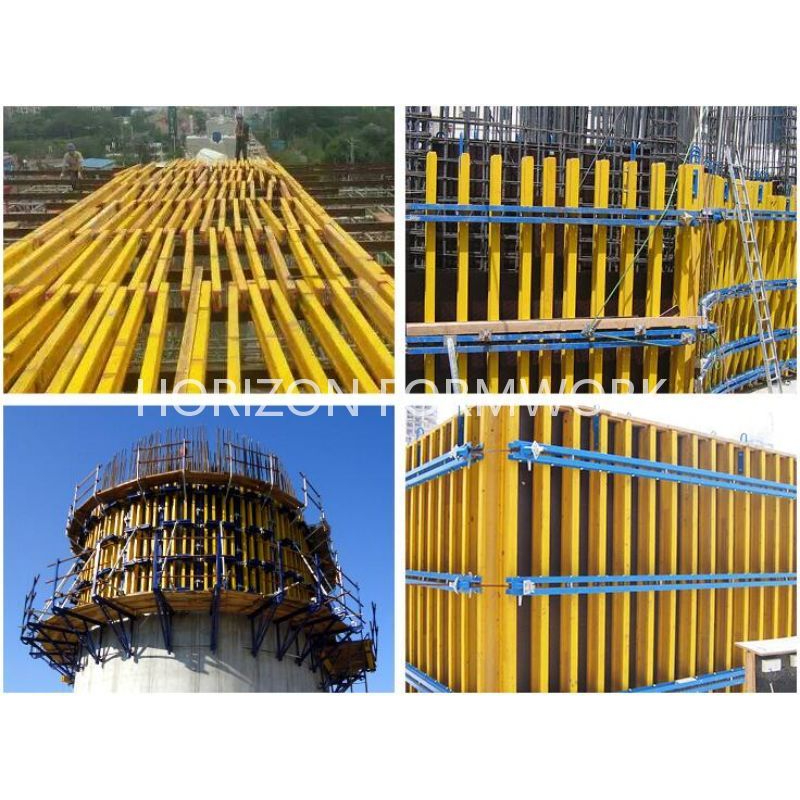
The versatility and strength of the H20 timber beam make it a preferred choice across a multitude of construction applications. Its design inherently offers several technical advantages over traditional lumber or steel alternatives:
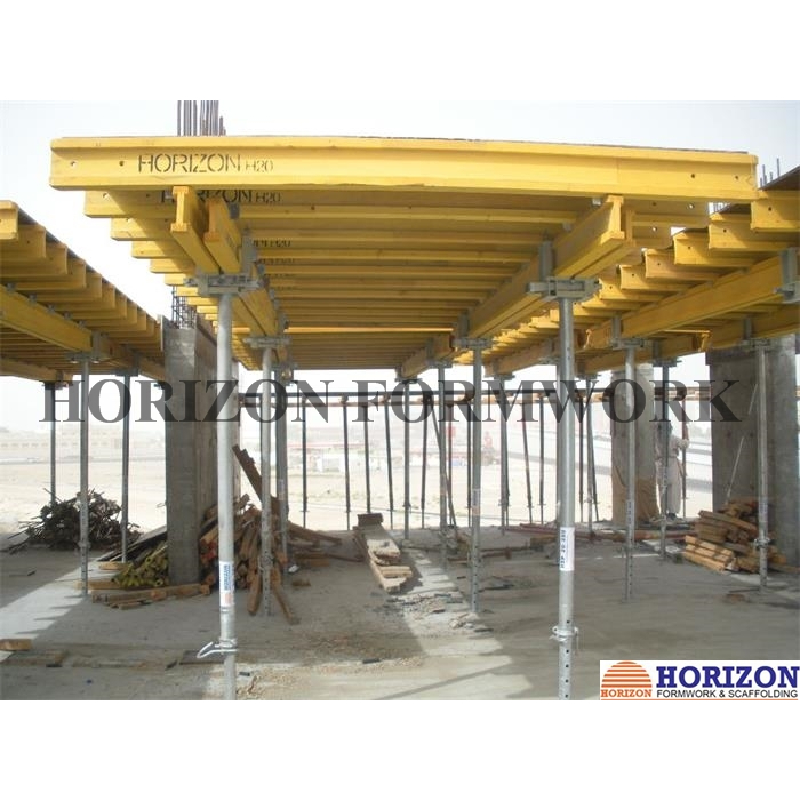
- Slab Formwork: As a primary component for slab formwork, the H20 timber beam for slab formwork provides robust support for concrete slabs of varying thicknesses and spans. Its consistent dimensions simplify grid layout and ensure a level soffit.
- Wall and Column Formwork: Integral to vertical formwork systems, H20 timber beams support plywood panels, transferring concrete pressure efficiently. This ensures perfectly plumb and dimensionally accurate walls and columns.
- Bridge Construction: Utilized in temporary support structures for bridge decks and abutments, leveraging its high load-bearing capacity and adaptability.
- Tunneling Projects: Provides essential temporary shoring and falsework support in tunnel construction, demonstrating resilience in challenging subterranean environments.
- Pre-fabricated Structures: Ideal for modular and pre-fabricated construction due to its standardized dimensions and ease of integration into off-site assembly processes.
Key Technical Advantages:
- High Strength-to-Weight Ratio: Facilitates easy handling and reduces crane dependency, optimizing labor efficiency on site.
- Consistent Quality: Manufactured under controlled conditions, ensuring uniform strength, stiffness, and dimensional stability, which is crucial for structural integrity.
- Durability & Reusability: Protective coatings and robust construction mean a significantly longer service life (20-30 reuses) compared to conventional timber, leading to lower per-use costs.
- Dimensional Stability: Less susceptible to warping or twisting than solid timber, ensuring precise formwork geometry.
- Cost-Effectiveness: Reduced material waste, longer lifespan, and efficient installation contribute to overall project cost savings.
- Environmental Benefits: Sourced from sustainable forests, H20 timber beams are a renewable resource, aligning with green building initiatives.
Vendor Comparison: Choosing the Right H20 Timber Beam Manufacturer
Selecting the right formwork H20 timber beam manufacturer is a strategic decision that impacts project timelines, budget, and quality. When evaluating suppliers, consider the following critical factors:
| Criterion | Horizon Form (Example) | Generic Supplier A | Generic Supplier B |
|---|---|---|---|
| Certifications & Standards | EN 13377, CE, ISO 9001 (consistent) | Variable (may lack specific EN/CE) | Local standards only |
| Material Quality | Sustainable, kiln-dried spruce/fir, high-strength MUF glue | Mixed timber quality, variable glue type | Untreated or lower-grade timber |
| Load-Bearing Capacity | Mmax 5.0 kNm, Qmax 11.0 kN (verified) | Self-declared, often lower | Unverified, potential safety risks |
| Protective Coating | Durable, water/UV-resistant (e.g., yellow) | Thin, less resistant, inconsistent | Often none or poor quality |
| Reusability/Service Life | 20-30 reuses (average) | 10-15 reuses | Limited (5-10 reuses) |
| Customization Options | Custom lengths, branding, specific coatings | Limited standard lengths | None |
| Customer Support | Technical assistance, prompt issue resolution, warranty | Basic sales support | Minimal to none |
When choosing an H20 timber beam manufacturer or supplier, prioritizing quality, adherence to international standards, and robust customer support ensures not only product performance but also long-term project viability and safety. Reputable formwork h20 timber beam suppliers often provide comprehensive technical documentation and case studies to validate their offerings.
Customized Solutions and Application Case Studies
Modern construction projects often require solutions tailored to unique architectural or structural demands. Leading H20 timber beam manufacturers, such as Horizon Form, excel in providing customized solutions that go beyond standard offerings. This includes specific beam lengths, custom branding, or specialized protective coatings for unique environmental conditions.
Customization Offerings:
- Non-Standard Lengths: While standard lengths are common, projects may require precise lengths to minimize cutting waste on site, a service readily available from advanced timber beam formwork suppliers.
- Proprietary Coatings: For projects in highly corrosive environments or requiring specific aesthetic finishes, manufacturers can apply bespoke protective layers.
- Integrated Logistics: Custom packaging and delivery schedules can be arranged to align with complex project logistics, ensuring just-in-time delivery and minimizing on-site storage requirements.
Application Case Studies:
Case Study 1: High-Rise Residential Complex, Metropolis City
A leading developer required a reliable and reusable formwork system for a 40-story residential tower. Horizon Form supplied over 5,000 linear meters of H20 timber beam for slab formwork, customized to specific floor plate dimensions. The consistent quality and high reusability (average 25 cycles per beam) significantly reduced overall material costs and project waste. Engineers praised the ease of integration with modular shoring systems, contributing to a 15% reduction in erection time per floor compared to previous projects.
Case Study 2: Infrastructure Project – Coastal Bridge Deck, Pacific Region
For a new bridge construction in a humid, salt-laden coastal environment, the project required H20 timber beams with enhanced corrosion and moisture resistance. Horizon Form delivered H20 timber beams with a specialized marine-grade protective coating. This customization ensured structural integrity and extended the lifespan of the temporary falsework, resisting the harsh environmental conditions and ensuring reliable support throughout the concrete curing process. The project completed on schedule, attributing part of its success to the durability of the formwork system.
Trustworthiness: FAQ, Lead Time, Warranty, and Support
Building trust with B2B clients necessitates transparent policies regarding product delivery, support, and guarantees. Horizon Form, as a reputable timber beam formwork company, prioritizes customer confidence through comprehensive information and service commitments.
Frequently Asked Questions (FAQ):
- Q: What is the typical lead time for H20 timber beam orders?
A: Standard orders typically have a lead time of 2-4 weeks, depending on quantity and specific customization. Expedited options are available upon request and project assessment. - Q: How many reuses can I expect from your H20 timber beams?
A: With proper handling, cleaning, and storage, our H20 timber beams are designed for 20-30 reuses, offering exceptional value and sustainability. - Q: Are your products certified to international standards?
A: Yes, all our H20 timber beams are manufactured in accordance with EN 13377 and carry CE marking, in addition to our ISO 9001 quality management certification. - Q: Do you offer technical support for formwork design?
A: Absolutely. Our expert engineering team provides technical consultation and support for optimal H20 timber beam integration into various formwork systems.
Lead Time & Fulfillment:
We maintain robust production capabilities and a streamlined logistics network, allowing us to manage large-volume orders effectively. For urgent requirements or complex global shipments, our team works closely with clients to develop optimized fulfillment strategies, leveraging our experience as a leading formwork h20 timber beam manufacturer.
Warranty Commitments:
Horizon Form backs its products with a comprehensive warranty against manufacturing defects, ensuring that our timber beam H20 products meet the highest quality benchmarks. Specific warranty details are provided with each quotation, reflecting our commitment to product excellence and customer satisfaction.
Customer Support:
Our dedicated customer support team is available to assist with inquiries, technical specifications, order tracking, and after-sales service. We believe in building lasting partnerships through proactive communication and responsive assistance, ensuring every project utilizing our h20 timber beam solutions is a success.
Conclusion: The Enduring Value of H20 Timber Beams
The timber beam H20 remains a cornerstone of modern formwork technology, offering an optimal blend of structural performance, reusability, and environmental responsibility. Its proven reliability in diverse application scenarios, coupled with ongoing advancements in manufacturing and protective coatings, solidifies its position as an indispensable component for efficient and safe construction.
For B2B stakeholders, investing in high-quality H20 timber beams from reputable formwork H20 timber beam manufacturers like Horizon Form translates into significant operational efficiencies, enhanced project safety, and long-term cost savings. As the construction industry continues to embrace innovation and sustainability, the H20 timber beam will undoubtedly remain at the forefront of superior formwork solutions.
References:
- European Committee for Standardization. (2009). EN 13377: Prefabricated timber formwork beams - Requirements, classification and assessment. Brussels, Belgium.
- Forest Stewardship Council. (2024). Certification Standards. Available at: https://fsc.org/en/document-centre
- International Organization for Standardization. (2015). ISO 9001:2015 - Quality management systems - Requirements. Geneva, Switzerland.
- Schnell, R. (2018). Timber Formwork Systems: Design, Construction, and Reusability. Journal of Construction Engineering and Management, 144(5), 04018029.
-
OEM Pipe Shuttering: Efficient, Durable Solutions for Global Construction
NewsDec.03,2025
-
OEM A-Frame Scaffolding: Durable & Safe Solutions for Global Construction Needs
NewsDec.03,2025
-
OEM Formwork and Scaffolding: Essential Solutions for Global Construction Efficiency
NewsDec.03,2025
-
OEM Quick Industrial Scaffolding: Fast, Safe, and Sustainable Solutions for Modern Industry
NewsDec.02,2025
-
What is OEM Permanent Formwork for Suspended Slabs? Benefits & Global Insights
NewsDec.02,2025
-
OEM Plastic Formworks for Concrete: Durable, Eco-friendly Solutions for Modern Construction
NewsDec.02,2025