febr . 25, 2026 14:35 Back to list
Shoring Props in Trenching: Ensuring Worker Safety in Excavation Projects
Excavation is inherently one of the most hazardous phases of any construction project. The moment the earth is opened to lay utility lines, build foundations, or install drainage systems, the natural stability of the soil is compromised. Without proper intervention, the immense pressure from the surrounding ground can cause a catastrophic cave-in, often with little to no warning. To mitigate these risks, the strategic use of a shoring prop system is essential. While many people associate these supports primarily with overhead concrete work, their role in trenching and excavation is a cornerstone of sub-surface safety.
The primary objective in trenching is to counteract the lateral pressure of the soil. This is achieved through a process of shoring and propping, where vertical and horizontal supports are used to reinforce the walls of the excavation. By creating a rigid internal skeleton within the trench, workers are protected from soil movement. The use of high-quality metal supports has largely replaced traditional timber bracing, offering a more reliable and faster way to secure a site. In the modern era, the reliability of these systems is what allows complex underground infrastructure to be built in even the most unstable soil conditions.
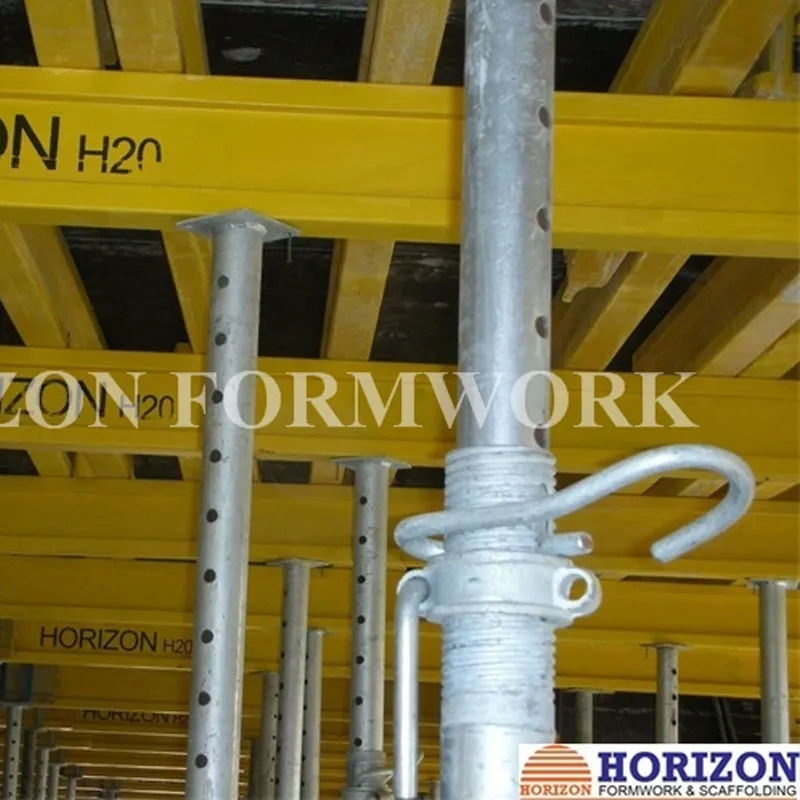
Horizontal Stability with the Adjustable Shoring Prop
In a trenching environment, the adjustable shoring prop serves a slightly different but equally vital purpose compared to its role in building construction. Instead of providing vertical support for a ceiling, the prop is often used horizontally as a "strut." These struts are placed between shoring shields or timber lagging to push back against the trench walls. The ability to fine-tune the length of the prop is critical here; because trench widths can vary due to soil displacement or imprecise digging, the threaded adjustment allows the safety crew to lock the support firmly into place with zero wiggle room.
The mechanical advantage of an adjustable shoring prop ensures that the support can be tightened until it exerts a proactive outward force. This "pre-loading" of the trench walls is a key safety measure, as it prevents the soil from beginning its initial movement. Once the soil starts to shift, the forces involved become much harder to stop. By using the precision threads of a high-quality prop, engineers can ensure that the shoring system is in total contact with the earth, providing a seamless transition of pressure that keeps the workspace inside the trench clear and secure for the duration of the utility installation.
Versatility in Deep Excavations with the Telescopic Shoring Prop
Deep trenches often present unique challenges where the distance between the shoring plates may change as the depth increases. The telescopic shoring prop is the ideal solution for these variable environments. Its two-part design—consisting of an inner and outer tube—allows it to span various widths without the need for custom-fabricated braces. On a busy excavation site, time is of the essence; the ability to quickly pull out a pin, extend the prop to the required width, and lock it back in place can save hours of labor every day.
Furthermore, the telescopic shoring prop is designed to be lightweight enough for manual handling while maintaining the extreme structural rigidity required for earth retention. In many trenching projects, space is at a premium, and heavy machinery may not be able to reach into the narrow opening to place supports. The portability of these telescopic units allows two workers to manually install the bracing as the excavation progresses. This "progressive shoring" ensures that at no point is a worker required to enter an unprotected trench, as the supports can be lowered and set from the safety of the ground level.
Structural Reinforcement with Steel Prop Shoring Posts
When dealing with high-pressure clay or saturated soils, the material strength of the support system is the only thing standing between safety and disaster. Steel prop shoring posts are the preferred choice for these high-stress scenarios due to their immense compressive strength. Steel does not suffer from the same environmental degradations as wood; it will not snap or splinter under a sudden shift in soil weight. Most professional contractors look for steel props that have been hot-dipped galvanized, ensuring that even in the damp, muddy conditions of an open trench, the metal will not succumb to rust or corrosion.
The use of steel prop shoring posts also provides a high level of predictability. Engineering charts can precisely dictate how much lateral force a specific steel post can handle at a given extension. This allows site supervisors to plan their propping and shoring layout with mathematical certainty. In large-scale civil engineering projects, such as the installation of massive sewage bypasses, the density and wall thickness of the steel posts provide the necessary safety margins to protect large crews working several meters below the surface. The rigidity of steel ensures that the shoring plates remain perfectly vertical, preventing the "tilting" effect that often precedes a trench wall failure.
Precision Tensioning via the Shoring Prop Jack Mechanism
Achieving the correct amount of tension in a trench brace is often a delicate operation. This is where the shoring prop jack mechanism becomes indispensable. The jack refers to the heavy-duty screw and handle assembly that allows the operator to exert massive outward pressure with relatively little physical effort. In a trench, simply placing a prop is not enough; it must be "jacked" into place to ensure it is actively supporting the load. This ensures that there is no slack in the system that could allow the soil to gain momentum.
The shoring prop jack also allows for the safe removal of the equipment. Once the underground work is complete and the backfilling process begins, the tension in the props must be released slowly. The screw mechanism allows the crew to gradually retract the prop, ensuring that the ground settles in a controlled manner. This controlled release is vital for preventing surface subsidence, which could damage nearby roads or existing buildings. The precision of the jack mechanism transforms the prop from a simple metal tube into a sophisticated safety instrument capable of managing the immense geological forces of the earth.
-
The Ultimate Guide to Shoring Props: Types, Sizes, and Applications
hírekFeb.25,2026
-
The Role of Shoring Props in Historical Building Restoration and Renovation
hírekFeb.25,2026
-
The Importance of Regular Maintenance and Inspection for Shoring Systems
hírekFeb.25,2026
-
Temporary Support Solutions: Using Shoring Props for Emergency Structural Repair
hírekFeb.25,2026
-
Steel vs. Aluminum Shoring Props: Which One Should You Choose?
hírekFeb.25,2026
-
Shoring Props in Trenching: Ensuring Worker Safety in Excavation Projects
hírekFeb.25,2026